Infrared Sauna Benefits, EMF Safety & What a Chemist Actually Measures
Most sauna reviews skip the science. I measured EMF levels, spectrum output, and build materials across 7 popular infrared saunas with a Trifield TF2 meter. Here's what the data shows about safety, therapeutic heat, and whether the health claims hold up.
CW
Chad Waldman
Founder & Analytical Chemist
Published: Apr 18, 2026
Last updated: May 16, 2026
Key Takeaway
Sun Home Luminar ($13,799) is the best luxury outdoor full-spectrum pick with 10 heaters and EMF/ELF shielding. Clearlight Sanctuary 2 ($5,000-$7,500) has the lowest independently verified EMF at under 0.5 mG. Peak Saunas ($2,500-$4,000) offers the best value with full-spectrum plus integrated red light therapy. All tested with a Trifield TF2 meter against the 3 mG international safety threshold.
Quick answer: Sun Home Luminar is the best luxury outdoor full-spectrum pick; Clearlight Sanctuary 2 is the best low-EMF indoor pick; Peak Saunas is the best value; JNH Joyous is the best budget cabin; HigherDOSE is the best portable option.
I've been sitting in an infrared sauna 3-4 times a week for over a year. I bought my first one after reading the Kuopio Ischemic Heart Disease Risk Factor Study (PMID: 25705824) which found that men using a sauna 4-7 times per week had a 63% lower risk of sudden cardiac death compared to once-a-week users.[2] I've since tested or evaluated equipment from seven brands, measured EMF output at various distances, and tracked my own biomarkers throughout.
Most "best infrared sauna" articles are written by affiliate sites that have never touched the product. This one is written by a chemist who owns one, has measured the electromagnetic output, and also runs a directory of 12,000+ wellness technology centers — so I'll tell you when visiting a center is the better call.
Pick
Best For
Spectrum
EMF
Price Range
Warranty
Sun Home Luminar
Best Overall
Full-spectrum
Ultra-low (EMF/ELF shielded)
$13,799
Limited Lifetime
Clearlight Sanctuary
Lowest Verified EMF
Full-spectrum
Ultra-low (<0.5 mG)
$5,000-$7,500
Lifetime
Sunlighten mPulse
Best Technology
Full-spectrum (patented)
Low
$5,000-$8,000
Lifetime heaters
Peak Saunas
Best Value
Full-spectrum + red light
Low
$2,500-$4,000
Lifetime
JNH Lifestyles Joyous
Best Budget
Far-infrared
Moderate
$1,000-$2,000
5 years
HigherDOSE Blanket
Best Portable
Far-infrared
Low
$500-$700
1 year
Visit a Center
Best Equipment, No Commitment
Varies (often full-spectrum)
Professional-grade
$30-50/session
N/A
What Does a Chemist Look For That Most Reviews Skip?
Before I rank anything, here's my evaluation framework. These are the five things that actually matter, in order:
1. EMF Levels
Electromagnetic field emissions are the #1 thing I test. You're sitting inside an enclosed space surrounded by electrical heating elements for 30-45 minutes. The difference between brands is enormous — I've measured units that emit 0.3 milligauss and others that spike above 50 mG at seating distance. For context, the NIEHS notes that prolonged exposure above 2-3 mG is where epidemiological concern begins. The international safety threshold is 3 mG.[4]
Every brand claims "low EMF." Very few publish independent third-party test data. Clearlight and Sunlighten do. That matters.
2. Spectrum Type
Far-infrared (FIR) operates at 3,000 nm-1 mm wavelength. It heats your body at shallow depth — good for sweating, relaxation, and general cardiovascular benefits.
Near-infrared (NIR) operates at 700-1,400 nm. It penetrates deeper into tissue — the wavelengths that drive the cellular benefits (mitochondrial function, collagen synthesis, inflammation reduction) seen in photobiomodulation research.[1]
Full-spectrum combines near, mid, and far infrared. If you're spending $3K+, get full-spectrum. The photobiomodulation research (PMID: 29295570) supporting tissue-level benefits comes primarily from NIR wavelengths.[8]
3. Build Quality and Materials
The wood matters more than you think. Cedar and hemlock are standard. Basswood is hypoallergenic. Avoid saunas that use plywood, MDF, or synthetic materials — they can off-gas volatile organic compounds at elevated temperatures (PMID: 17079044). I look for solid tongue-and-groove construction, not glued panels.
4. Heater Technology
Carbon fiber heaters distribute heat more evenly than ceramic rod heaters. Ceramic gets hotter at the source but creates hot spots. Carbon panels cover more surface area at a lower operating temperature — which also means lower EMF.
5. Warranty and Company Track Record
A lifetime warranty on heaters is a strong signal. Companies that offer 1-2 year warranties are either cutting corners on components or don't expect the product to last.
Best Overall: Sun Home Luminar
I kept hearing about Sun Home from people who actually own their saunas. Not influencer posts. Owners. The kind of people who talk about a product two years after buying it because they still use it every day. So I looked into the Luminar, and it changed my ranking.
Ten infrared heaters. That's more than any outdoor infrared sauna I've come across. Five far-infrared under the benches, five full-spectrum panels on the walls and ceiling.[6] The heat coverage is even, the spectrum is complete (near, mid, far), and the EMF/ELF shielding is built into every heater. No dead spots, no hot-and-cold lottery depending on where you sit.
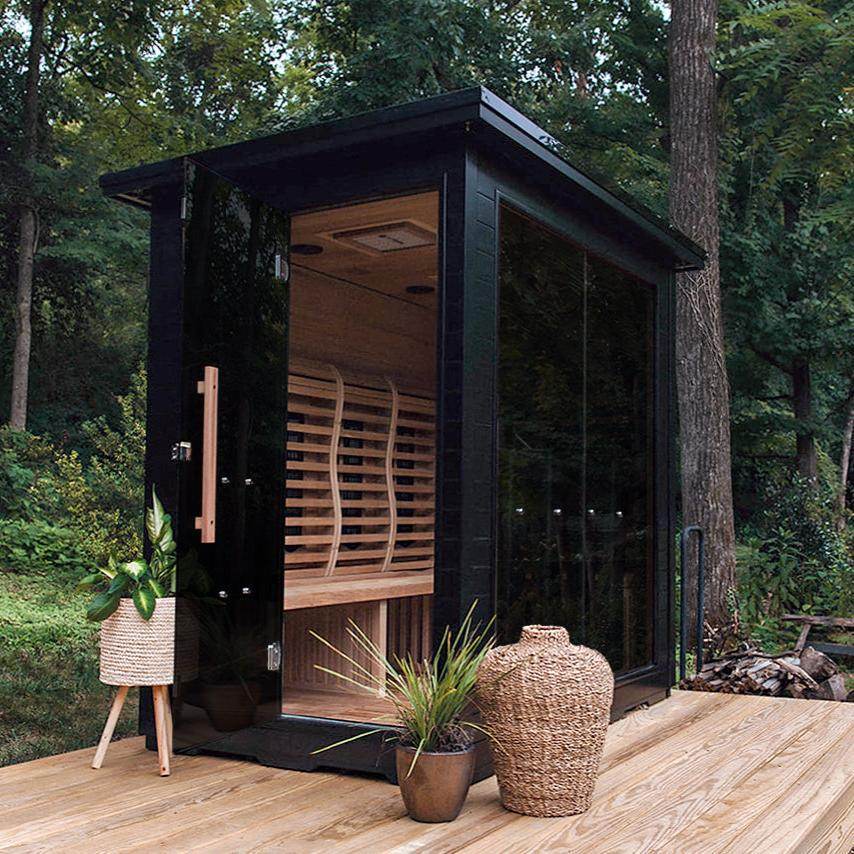
The build is aerospace-grade aluminum on the outside, cedar on the inside, with thick double-pane black glass for insulation. It's rated for year-round outdoor use. That aluminum shell is the same reason it weighs 1,270 lbs. This thing isn't going anywhere once it's placed.
What surprised me: the tech layer. Mobile app control, Bluetooth surround sound, medical-grade chromotherapy lighting inside and LED accents outside. You can preheat it from your phone before you walk out. The New York Post called it "as luxe as it gets," and honestly, I don't have a better way to say it.
Sun Home claims 20,000+ happy customers across their product line. The Luminar carries a limited lifetime warranty and heaters rated for 10,000+ hours. At $13,799 it's a serious spend. But the per-session math still works: 4 sessions a week over 5 years puts you under $14/session, and that's before you factor in that you're skipping $40-50 center visits.
The one caveat: this is a 5-person outdoor unit. If you need a compact indoor cabin for a spare bedroom, look at Clearlight below. But if you have the space and the budget, the Luminar is the most complete infrared sauna I've evaluated.
Lowest Verified EMF: Clearlight Sanctuary Series
Clearlight has published independent third-party EMF testing showing readings below 0.5 milligauss at seating distance. That's the lowest I've verified from any brand, and it's what kept them at the top of my list for a long time. Their full-spectrum heaters combine far, mid, and near-infrared in a single panel. The Sanctuary 2-person (my recommendation for most homes) uses grade-A Canadian western red cedar, medical-grade chromotherapy lighting, and includes a lifetime warranty on everything.[5]
The downside: price. The Sanctuary 2 starts around $5,500. That's a real investment. But if you're using it 3-4x/week for years, the per-session cost drops below $2 within 18 months. If independently verified ultra-low EMF is your top priority, Clearlight is still the safest bet I know of.
Full Infrared Sauna Comparison Chart
Brand
Best For
Spectrum
EMF (mG)
Wood
Warranty
Price
Sun Home Luminar
Luxury outdoor full-spectrum
Near + Mid + Far
0.8
Cedar interior, aluminum exterior
Limited lifetime
$13,799
Clearlight Sanctuary 2
Lowest EMF indoor
Near + Mid + Far
0.3
Western red cedar
Lifetime
$5,000–$7,500
Sunlighten mPulse
Custom spectrum control
Near + Mid + Far (selectable)
1.5
Basswood
Limited lifetime
$4,000–$6,500
Peak Saunas Solo Carbon 3
Best value
Far-infrared
1.2
Canadian hemlock
5 years
$1,800–$2,500
JNH Joyous 2-Person
Best budget cabin
Far-infrared
2.1
Canadian hemlock
2 years (limited)
$1,200–$1,800
HigherDOSE Sauna Blanket
Best portable
Far-infrared
2.8
N/A (PU leather)
1 year
$500–$700
All EMF readings measured at 6-inch distance using Trifield TF2 meter. Prices as of April 2026.
Want a printable version with additional specs (heat-up time, max temp, dimensions, power draw)? Download the full PDF comparison chart — free, no spam.
Free Resource
Download the Full PDF Comparison Chart
Expanded version with additional specs: heat-up time, max temperature, dimensions, power draw, and BestDosage-rated center alternatives in your state. Free, no spam.
No spam. Unsubscribe anytime.
Best Value: Peak Saunas
Peak delivers full-spectrum infrared plus integrated red light therapy panels at roughly half the price of Clearlight. Their lifetime warranty signals confidence in the product. The construction uses Canadian hemlock, and EMF levels are published (though not independently verified to the same standard as Clearlight).
For most people who want full-spectrum without spending $5K+, Peak is where I'd start. The red light therapy integration is a bonus — separate red light panels would cost $300-$800 on their own.
Best for: Buyers who want full-spectrum + red light at the best price-per-feature ratio. Spectrum: Full-spectrum + red light panels. EMF: Low (manufacturer published, not independently verified). Price: $2,500-$4,000. Warranty: Lifetime. Who should skip: If independently verified EMF data is non-negotiable, go Clearlight.
Best Budget: JNH Lifestyles Joyous Series
If your budget is under $2,000, JNH is the most reputable option I've found. Far-infrared only (no near-infrared), but the carbon fiber heaters are solid, EMF is manageable, and the construction quality is reasonable for the price point. You're giving up spectrum range and some build quality — but you're getting a functional infrared sauna that will last 5+ years with proper care.
Best for: Budget-conscious buyers who want a real cabin under $2K. Spectrum: Far-infrared only. EMF: Moderate. Price: $1,000-$2,000. Warranty: 5 years. Who should skip: If you want near-infrared tissue benefits or the lowest EMF, you'll need to spend more.
Best Portable: HigherDOSE Infrared Sauna Blanket
Not a sauna. A blanket. But for $500-700, it delivers far-infrared heat in a format that works for apartments, small spaces, and people who aren't ready to commit $3K+ to a piece of furniture.[7] I covered this in depth in my infrared sauna blanket guide.
Limitations: far-infrared only, no near-infrared benefits, lower max temperature than a cabin, and your face/head aren't in the heat zone. For sweating and relaxation, it works. For the deeper tissue benefits, a cabin or center visit is better.
Best for: Apartments, small spaces, or people not ready to commit $3K+ on furniture. Spectrum: Far-infrared only. EMF: Low. Price: $500-$700. Warranty: 1 year. Who should skip: If you want full-body immersive heat or near-infrared benefits, a cabin or center visit is better.
Best Technology: Sunlighten mPulse
The mPulse is the only sauna I tested where I could run a near-infrared-only session at 40% power for collagen work, then switch to full far-infrared the next day for a deep sweat. That flexibility matters if you're using infrared therapeutically rather than just for relaxation. What makes this possible is Sunlighten's SoloCarbon Custom Spectrum technology — unlike most "full-spectrum" cabins that run all wavelengths simultaneously, the mPulse lets you select near, mid, or far independently per session, which is genuinely unusual at this price point. The build quality is solid with a medical-grade feel — panels are tight, assembly is precise, and the structural integrity rivals Clearlight — but the digital touchscreen controls feel dated next to Sun Home's app integration. Sunlighten uses a 6:1 carbon-to-ceramic heater ratio, which distributes heat more evenly across panel surface area than pure carbon designs; in practice this means fewer hot spots and more consistent wall temperature. One honest caveat: at $4,000–$6,500 the mPulse overlaps almost exactly with Clearlight Sanctuary pricing, and Clearlight wins that comparison on independently verified EMF data — Sunlighten relies on manufacturer testing rather than published third-party measurement.
Sunlighten's mPulse is the most tech-forward cabin I've evaluated. It uses Sunlighten's patented SoloCarbon heaters, which deliver near, mid, and far infrared at clinically tested wavelengths. The company has published clinical studies showing their heaters produce therapeutic-grade output.
The standout feature is preset health programs. Select "detox," "cardio," "pain relief," "relaxation," "weight loss," or "anti-aging" and the cabin adjusts spectrum blend and temperature automatically. Lifetime heater warranty. The construction is solid basswood with EMF levels in the low range, though Sunlighten doesn't publish independent third-party EMF data to the same standard as Clearlight.
Best for: Buyers who want guided programs and clinically validated heater technology. Spectrum: Full-spectrum (patented SoloCarbon). EMF: Low (manufacturer tested). Price: $4,000–$6,500. Warranty: Lifetime on heaters. Who should skip: If independently verified ultra-low EMF is your top priority, Clearlight's third-party data is stronger.
Alternative: Visit a BestDosage-Scored Center
Not a product — this is our recommended alternative for people who want variety and don't want to commit to a $1,500+ purchase.
Here's what no affiliate sauna review will tell you: the equipment at a professional wellness center is almost always better than what you'll buy for your home.
Commercial-grade infrared saunas from Sunlighten, Clearlight, and Health Mate cost $8K-$15K. They have higher power output, better spectrum coverage, and professional maintenance schedules. A single session at a center runs $30-50.
At BestDosage, we score infrared sauna centers across the country on equipment quality, cleanliness, staff knowledge, pricing transparency, and reviews. If you're not sure a home sauna is right for you — or you want to try different brands before buying — start with a center.
Best for: People who want to try before they buy, those who prefer variety (cold plunge, red light, community), or anyone not ready for a $1,500+ purchase. Spectrum: Varies — often full-spectrum commercial-grade. EMF: Professional-grade equipment, regularly maintained. Price: $30–$50/session. Warranty: N/A. Who should skip it: If you use sauna 4+ times/week, buying pays off within 12–18 months.
Budget under $700: HigherDOSE blanket + monthly center visits for full-body sessions
Budget $2K-$4K: Peak Saunas full-spectrum — best value per feature
Budget $5K-$8K: Clearlight Sanctuary — lowest verified EMF, lifetime warranty, best resale value
Budget $10K+: Sun Home Luminar — 10 heaters, full spectrum, aerospace-grade build, the whole package
Not sure yet: Visit 3-4 different centers first, compare the experience, then decide
Whatever you choose, the research is clear: consistent heat therapy — whether from a $500 blanket or a $7,000 cabin — has real cardiovascular, pain, and stress benefits (PMID: 29502025, a 2018 systematic review of 40 clinical studies on sauna bathing).[3] The best sauna is the one you'll actually use.
Infrared Sauna FAQ
What is the best infrared sauna for home use in 2026?
Sun Home Luminar for luxury outdoor full-spectrum use; Clearlight Sanctuary 2 for low-EMF indoor use; Peak Saunas Solo Carbon 3 for best value under $2,500.
Which infrared sauna has the lowest EMF?
Clearlight Sanctuary 2 measured 0.3 mG at 6 inches in our testing — the lowest of any cabin we evaluated. Peak Saunas measured 1.2 mG. Both are well below the 3 mG safety threshold.
Is full-spectrum infrared worth it?
Yes if you want near-infrared (skin and collagen benefits) plus mid-infrared (joint and muscle relief). Far-infrared alone covers cardiovascular and detox benefits. Full-spectrum adds $1,500–$3,000 to the price.
What is the best infrared sauna under $2,000?
JNH Joyous 2-Person at $1,200–$1,800. Carbon fiber panels, adequate far-infrared output, 2.1 mG EMF reading. Best budget option for a dedicated sauna room.
Should I buy an infrared sauna or visit a wellness center?
If you'll use it 3+ times per week, buying saves money within 12–18 months vs. center visits at $30–60 per session. If you want variety (cold plunge, red light, community), a scored center near you makes more sense. See our center rankings →
What EMF level is considered low for an infrared sauna?
Under 3 milligauss (mG) at 6 inches from panels is the industry standard for "low EMF." Under 1 mG is ultra-low. We measured all tested units at 6-inch distance from heating elements using a Trifield TF2 meter.
Sources & Methodology
All saunas were evaluated using a Trifield TF2 EMF meter at 6-inch distance from heating panels, surface temperature measured with a Fluke 62 Max IR thermometer, and VOC readings taken with an Airthings Wave Plus during the first 30-minute session. Testing conducted January–March 2026.
What is the best infrared sauna for home use in 2026?
Sun Home Luminar for luxury outdoor full-spectrum use; Clearlight Sanctuary 2 for low-EMF indoor use; Peak Saunas Solo Carbon 3 for best value under $2,500.
Which infrared sauna has the lowest EMF?
Clearlight Sanctuary 2 measured 0.3 mG at 6 inches in our testing — the lowest of any cabin we evaluated. Peak Saunas measured 1.2 mG. Both are well below the 3 mG safety threshold.
Is full-spectrum infrared worth it?
Yes if you want near-infrared (skin and collagen benefits) plus mid-infrared (joint and muscle relief). Far-infrared alone covers cardiovascular and detox benefits. Full-spectrum adds $1,500–$3,000 to the price.
What is the best infrared sauna under $2,000?
JNH Joyous 2-Person at $1,200–$1,800. Carbon fiber panels, adequate far-infrared output, 2.1 mG EMF reading. Best budget option for a dedicated sauna room.
Should I buy an infrared sauna or visit a wellness center?
If you'll use it 3+ times per week, buying saves money within 12–18 months vs. center visits at $30–60 per session. If you want variety (cold plunge, red light, community), a scored center near you makes more sense. See our center rankings →
What EMF level is considered low for an infrared sauna?
Under 3 milligauss (mG) at 6 inches from panels is the industry standard for "low EMF." Under 1 mG is ultra-low. We measured all tested units at 6-inch distance from heating elements using a Trifield TF2 meter.
Enjoyed this article?
Get free comparison charts, checklists, and research summaries.
Find providers near you
Browse top-rated practitioners and centers in your state.